


Refrigerated Air Dryer
Industrial Refrigerated Air Dryer for Compressed Air Systems
Industrial refrigerated air dryers remove moisture from compressed air to help protect pneumatic equipment, production machinery, and downstream air distribution systems. They are widely used in manufacturing plants, automotive workshops, packaging lines, and industrial automation systems.
For air compressor manufacturers, industrial equipment distributors, OEM buyers, and engineering contractors, selecting the right refrigerated air dryer requires more than matching nominal airflow. Inlet air temperature, operating pressure, ambient conditions, required pressure dew point, and pressure drop all affect dryer selection and system performance.
Standard, energy-saving, and high-inlet-temperature configurations are available for different compressed air requirements. Model selection should be based on actual operating conditions and verified technical specifications.


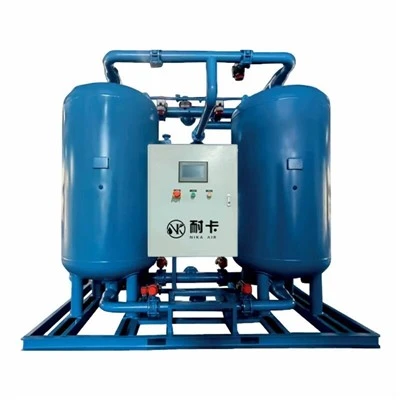

Product Overview and Applications
Typical Applications
Automotive Manufacturing
Compressed air for pneumatic assembly tools, control systems, and auxiliary processes.
CNC Machining and Industrial Automation
Dry air for pneumatic actuators, solenoid valves, and automated production equipment.
Packaging and Assembly
Moisture-controlled compressed air for pneumatic handling and production machinery.
Textile and Printing
Compressed air for air jets, pneumatic controls, and equipment sensitive to moisture.
General Manufacturing
Plant air systems serving workshops, machinery, and production utilities.
Note
For applications with strict requirements for oil content, particulate levels, sterile air, or low dew points, additional filtration or a different drying technology may be required.
Technical Specifications
The following ranges are indicative selection references rather than guaranteed specifications for every model. Confirm the applicable values against the selected model's technical data sheet and rated operating conditions.
|
Technical Parameter |
Typical Reference or Configuration |
|
Rated Airflow Capacity |
Model-dependent; available in different capacities for small and large industrial systems |
|
Standard Operating Pressure |
Commonly 7 to 10 bar |
|
High-Pressure Configuration |
Available on selected models; confirm maximum working pressure |
|
Pressure Dew Point |
Approximately plus 3 degrees Celsius for many standard models under rated conditions |
|
Maximum Inlet Air Temperature |
Common standard rating may be up to 45 degrees Celsius; high-temperature models require separate confirmation |
|
Maximum Ambient Temperature |
Model-dependent; confirm the rated limit |
|
Power Supply |
Depending on model: 220 to 240 V single-phase or 380 to 415 V three-phase |
|
Operating Frequency |
50 Hz or 60 Hz, subject to model configuration |
|
Refrigerant |
Depends on model, refrigerant circuit design, and destination-market requirements |
|
Pressure Drop |
Confirm the rated value at the specified airflow and operating conditions |
|
Condensate Drain |
Timed electronic drain or zero-loss drain, depending on configuration |
|
Installation |
Floor-mounted or integrated package, depending on model |
|
Air Connections |
Size and connection type confirmed by model |
When comparing suppliers, check that airflow capacity and pressure dew point are stated at comparable inlet temperatures, operating pressures, and ambient conditions. A nominal capacity rating alone does not establish that a dryer will meet the requirements of a specific installation.
For technical evaluation, request the model-specific airflow, rated power consumption, dimensions, weight, connection sizes, refrigerant details, and installation requirements.
Types and Configurations

Standard Refrigerated Air Dryers
Designed for general industrial compressed air systems operating within specified inlet and ambient temperature limits. They are suitable for many manufacturing plants, workshops, and pneumatic equipment installations.
Energy-Saving Cycling Dryers
Use thermal storage or demand-based refrigeration control to reduce unnecessary compressor operation when the cooling load decreases. Actual energy savings depend on load variation, ambient temperature, system design, and operating hours.
Purchasing tip: Request power consumption data under defined load conditions rather than relying on a general percentage-saving claim.
High-Inlet-Temperature Refrigerated Air Dryers
Designed for compressed air systems with inlet temperatures above the limits of standard models. Depending on compressor discharge conditions and dryer design, an upstream aftercooler may still be required. Confirm the maximum rated inlet temperature and available drying capacity at expected operating conditions before selection.
High-Ambient-Temperature Models
Suitable for installations where the surrounding temperature approaches or exceeds the operating limits of standard models. Condenser capacity, ventilation, installation clearance, and the rated ambient temperature should be checked during selection.
Integrated Air Treatment Packages
Can combine a refrigerated air dryer with compatible pre-filters, after-filters, condensate drains, and other specified accessories. The final configuration should reflect required air quality, allowable pressure drop, maintenance access, and installation layout.

How to Select the Right Refrigerated Air Dryer
Match Airflow Capacity to Actual Demand: Determine maximum compressed air demand and the compressor's actual delivered airflow. Consider simultaneous equipment operation, peak demand, and planned production expansion. Apply manufacturer correction factors when actual conditions differ from rated conditions.
Confirm Inlet Air Temperature: Higher inlet temperatures increase cooling loads and reduce available drying capacity. If compressor discharge temperature exceeds the rated inlet limit, incorporate an aftercooler or select a high-temperature model.
Check Ambient Operating Conditions: High ambient temperatures hinder condenser heat rejection. Confirm maximum rated ambient limits and ensure adequate ventilation and clearance, especially in hot climates or enclosed equipment rooms.
Define Required Pressure Dew Point: Standard dryers provide a dew point around plus 3 degrees Celsius. Applications demanding substantially lower dew points (such as minus 40 degrees Celsius) require a desiccant dryer.
Evaluate Pressure Drop and Energy Consumption: Compare pressure drop at required airflow rates and evaluate rated power consumption against expected operating hours to prevent excessive energy loss.
Select Appropriate Filtration and Drainage: Utilize coalescing filters for oil aerosols and particulate filters for solid contaminants. Choose zero-loss drains over poorly adjusted timed drains to eliminate unnecessary compressed air loss.
Quality Control, Inspection, and Testing
For industrial buyers, quality assurance should cover pressure integrity, refrigeration circuit operation, electrical safety, and drying performance.
Factory Quality Checks
May include refrigeration circuit leak testing, air-side connection and heat exchanger inspection, condensate drainage checks, electrical safety verification, operational testing, and performance verification against specified conditions.
Final Inspection
Covers model identification, accessories, packaging, and supplied documentation.
Project Alignment
For OEM orders and engineering projects, inspection methods and acceptance criteria must be agreed upon prior to production. Request inspection records and compliance documentation during the quotation stage to support technical approval.
OEM and Customization
Industrial refrigerated air dryers can be configured for equipment integration, distribution programs, and project-specific requirements:
Electrical Configuration: Supply voltage, phase, frequency, and control panel design.
Control Systems: Operating indicators, alarms, control logic, and supported communication interfaces.
Condensate Drainage: Timed electronic drains or zero-loss drain options.
Air Treatment Accessories: Compatible pre-filters, after-filters, and designated components.
Enclosure and Labeling: Enclosure finish, product identification, and private-label requirements.
Mechanical Interfaces: Air connections, mounting arrangements, and service access layouts.
Confirm technical specifications, interface dimensions, labeling, and inspection criteria before mass production. Customization availability depends on model selection, order volume, and technical feasibility.

Bulk Supply and Project Support
For importers, distributors, compressor manufacturers, and engineering contractors, a clearly defined supply specification helps reduce ordering errors and installation delays. Project support includes model selection, configuration confirmation, technical documentation, export packaging, and shipment coordination.
Before placing a bulk order, confirm:
Product Configuration
Model numbers and order quantities.
Operating Requirements
Rated airflow, operating pressure, and required pressure dew point.
Electrical Requirements
Voltage, phase, and frequency.
Installation Requirements
Air connection sizes and installation dimensions.
Accessories
Included filters, drains, and other components.
Documentation
Required inspection records and compliance documents.
Shipping
Packaging specifications and shipping destination.
After-Sales Support
Spare parts availability, warranty terms, and service arrangements.
Delivery Schedule
Production lead time and expected delivery date.
Frequently Asked Questions

Request a Quote for an Industrial Refrigerated Air Dryer
Looking for a refrigerated air dryer for distribution, OEM integration, or an industrial compressed air project? Send your operating requirements to receive a suitable configuration recommendation and quotation.
Please provide the following details to help establish a suitable model, clarify the scope of supply, and prepare an accurate quotation:
Required airflow and unit of measurement
Operating pressure
Maximum inlet air temperature
Maximum ambient temperature
Required pressure dew point
Voltage, phase, and frequency
Intended application and order quantity
Required accessories, documentation, and customization
With abundant experience, we are one of the most professional refrigerated air dryer manufacturers and suppliers in China. Please feel free to buy customized refrigerated air dryer made in China here from our factory. For quotation, contact us now.
Explosion Proof Adsorption Dryer, Micro Heat Regenerative Desiccant Dryer, Modular Desiccant Air Dryer