


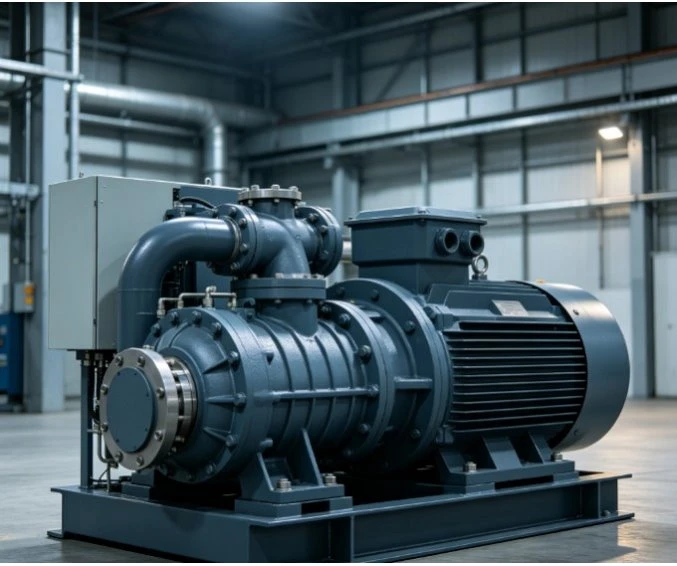
Product Overview
Two-Stage High Pressure Screw Compressors are engineered for industrial applications where standard 7 bar to 13 bar factory air is insufficient. By dividing the compression ratio across two sequential stages, these units deliver stable, high-pressure air for continuous heavy-duty operation.
Typical industrial models within this category operate at 45 kW to 450 kW, providing approximately 2.8 m³/min to 50 m³/min of air delivery at maximum working pressures ranging from 25 bar to 35 bar.
Product at a Glance
|
Product at a Glance Technical Parameter |
Specification Profile |
|
Compressor Type |
Oil-Injected Rotary Screw |
|
Compression Stage |
Two-Stage Compression |
|
Pressure Range |
25 bar – 35 bar (Up to approx.) |
|
Motor Power |
45 kW – 450 kW |
|
Air Delivery (FAD) |
2.8 m³/min – 50 m³/min |
|
Drive Options |
Fixed Speed / Variable Frequency Drive (VFD) |
|
Cooling System |
Air-Cooled or Water-Cooled |
|
Control System |
Programmable Logic Controller (PLC) |
|
Air Quality |
Oil-injected; downstream treatment required per process |
Engineering Advantages and Structural Characteristics
Optimized Two-Stage Rotor Profile Design
The asymmetrical rotor profiles of the first and second stages are engineered with distinct lobe ratios to minimize internal leakage and optimize volumetric efficiency across high pressure differentials.
Low Pressure Ratio Per Stage Thermal Management
Dividing the total compression work between two stages lowers the operating temperature in each individual chamber, reducing thermal stress on bearings, seals, and lubricants during continuous heavy-duty operation.
Heavy-Duty Industrial Base Frame and Enclosure
Constructed from heavy-gauge structural steel with vibration-dampening mountings, the package design minimizes mechanical vibration and accommodates continuous high-pressure pulsation without structural fatigue.
Precision-Engineered Interstage Cooling Arrangement
The interstage piping and cooling loop effectively reduce the temperature of the air entering the second stage, enhancing overall thermodynamic efficiency and reducing specific energy consumption per cubic meter of air delivered.
Integrated Intelligent Monitoring and Protection System
The microprocessor-based controller continuously monitors critical operating parameters-including discharge pressure, interstage temperature, oil level, motor load, and filter differential pressure-providing automated safety shutdowns and diagnostic error logging.
Typical Industrial Applications
PET Bottle Blowing & Preforming
Demands high-pressure air surges synchronized with strict production cycles and consistent air purity.
Industrial Process Air
Specialized chemical, energy, and manufacturing processes requiring uninterrupted pressure above standard utility limits.
Pressure Testing & Heavy Manufacturing
High-pressure operational testing for industrial equipment, valves, and pipelines.
High-Pressure System Integration Checklist
A compressor is only one component of a high-pressure network. Every downstream element must match the system pressure rating:
Air Receiver
Must feature certified pressure vessel ratings matching maximum discharge pressure.
Air Dryers
Sourced for high inlet pressure, flow capacity, and required pressure dew point.
Filtration Hierarchy
Coalescing and particulate filters must handle operating pressures without excessive pressure drop.
Piping & Valves
High-pressure seamless piping, threaded or flanged connections, and safety relief valves rated accordingly.
Site Preparation & Installation Guidelines
Foundation & Leveling
Install the unit on a flat, rigid concrete floor capable of supporting total operating weight and dynamic vibration loads. Use precision shims and anti-vibration mountings to prevent frame distortion.
Ventilation & Water Supply
Air-Cooled: Ensure adequate room ventilation and ducted exhaust airflow to maintain ambient temperatures within safe operating limits.
Water-Cooled: Verify that cooling water pressure, flow rate, and water quality parameters meet factory specifications to prevent heat exchanger scaling.
Electrical Connections
Dimension incoming power cables, circuit breakers, and disconnect switches based on motor full-load amperes (FLA). Confirm correct phase sequence, local voltage matching, and secure grounding prior to energizing.
Pre-Startup Verification
Check compressor fluid levels using the specified high-pressure lubricant. Inspect all mechanical flanges, high-pressure piping joints, and electrical terminal connections for transit security.
Commissioning Protocol
Perform initial startup under no-load conditions to verify correct motor rotation, oil pressure buildup, and safety shutdown responses before transitioning the system to full operational load.
FAQ
Q: What is the primary operational difference between a standard single-stage screw compressor and a two-stage high-pressure model?
A: A standard single-stage unit compresses air from atmospheric pressure to the final target in one continuous action, which becomes thermally and mechanically inefficient at elevated pressures. A two-stage compressor splits the compression ratio across two separate airends, incorporating interstage cooling. This configuration reduces internal operating temperatures, minimizes leakage, and maintains volumetric efficiency at discharge pressures ranging from 25 bar to 35 bar.
Q: Why is FAD (Free Air Delivery) specified at pressure more critical than displacement for high-pressure applications?
A: Displacement ratings only measure physical swept volume and do not account for volumetric losses caused by high compression ratios. In high-pressure operations, internal leakage increases. Specifying actual FAD at the required working pressure (e.g., 30 bar) ensures that the delivered airflow genuinely satisfies downstream process equipment without unexpected pressure drops.
Q: How does ambient temperature and installation altitude affect high-pressure screw compressor sizing?
A: Elevated ambient temperatures reduce cooling efficiency and air density, while high altitudes decrease atmospheric air mass flow. Both factors require de-rating the compressor package or upgrading the cooling system (such as switching from air-cooled to water-cooled configurations) to prevent thermal shutdowns and maintain rated output during continuous operation.
Q: Is downstream air treatment mandatory for oil-injected high-pressure screw compressors?
A: Yes. Because oil-injected compressors use lubricant for rotor sealing and cooling, residual oil vapor and moisture enter the compressed air stream. Applications requiring clean or process-grade air must integrate a properly rated high-pressure aftercooler, water separator, coalescing filters, and specialized purification stages downstream.
Q: What critical electrical parameters must be confirmed before ordering an imported high-pressure compressor package?
A: Procurement and electrical engineering teams must verify local grid compatibility, including voltage, frequency, phase, motor efficiency compliance (such as IE3/IE4 standards), starting methods (e.g., soft starter or VFD response), and ambient control panel enclosure ratings to ensure safe integration into the facility's power infrastructure.
Hot Tags: two-stage high pressure screw compressor, China two-stage high pressure screw compressor manufacturers, suppliers, factory, Compressor Positive Displacement, low noise electric air compressor system, modular electric air compressor system, portable electric air compressor system, thermal stability air compressor system, three phase electric air compressor